Fire
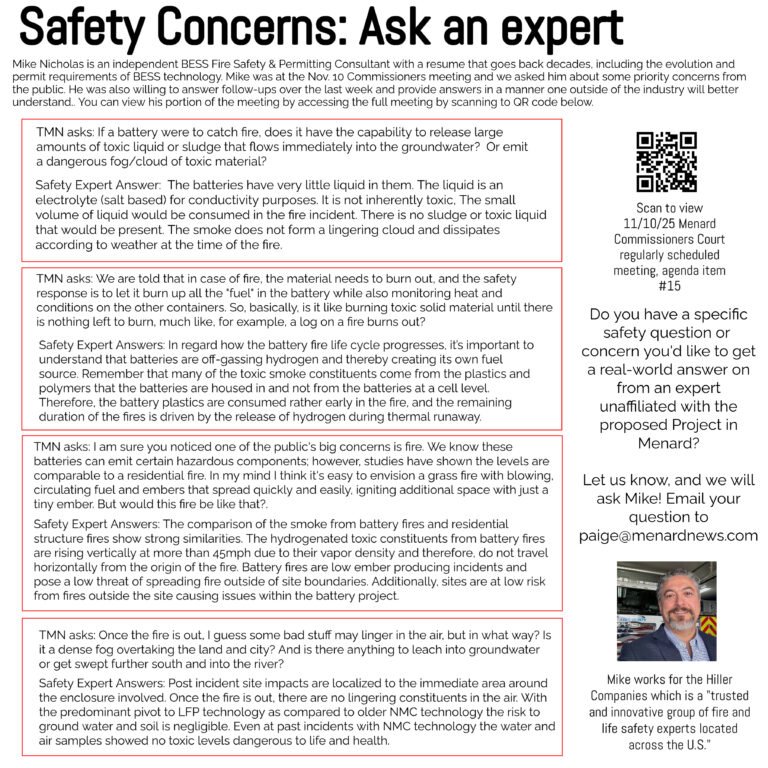
In the unlikely event of that an element of the BESS catches fire (via thermal runaway) it is almost always accepted practice to let it burn.
Why? Because that is what research has shown is the safest and most effective approach. The fires are unlikely to spread so, if first responders are there to monitor and keep an eye on things, just-in-case, that has proven to be more effective than dragging out a bunch of chemicals and/or wasting a ton of water that will not extinguish the blaze anyway.
Some of the derogatory things being said about whether our VOLUNTEER fire department could handle a BESS incident is flat out ridiculous. The VFD has had private meetings with safety experts and has direct contact with developers as this project progresses. They are confident in their ability to respond. If you are not confident in their ability, maybe consider a relocation.
Safety Stuff
There are legitimate safety concerns with this technology, but it is fascinating how quickly it evolves to be safer and more effective.
We all hear about lithium battery fires— from electric scooters to battery storage grids. The good news is that the risk of one of these batteries experiencing thermal runaway (the “it” term to incite fear of fire) and catching fire is diminishing in a hurry.
The racks of batteries in the containers are packaged and sealed… because the industry learned the hard way that water and lithium batteries do not mix—think of all the burned up Tesla cars we saw from the hurricane in Florida.
I don’t know about the cars, but BESS people have their batteries packed up tight now. The site operation is also heavily automated. If one were to heat up, the system automatically shuts it off and disconnects it from the others faster than a human watching could notice and react. Experience has also taught the industry how far apart the batteries should be to avoid fire spreading.
Not to say there is no risk of fire… there certainly is. But the actual odds of one catching fire are probably less risky than getting in your car to drive to the coffee shop, not to mention lighting that third cigarette of the day.
Soil & Water
Soil and water contamination risk is not what I was expecting at all. I think it is easy to hear “battery” and think huge, commercial sized acid-filled car batteries, but that is not the case.
The small amount of liquid in a lithium battery is a salt-based electrolyte that is not inherently toxic. That part will be consumed quickly in a fire. There is no toxic liquid or sludge or any fluid onsite that can leak out and seep into the ground or water from a fire.
Like air quality, these two concerns have also been extensively studied, and instances show no elevated soil or water contamination during or after a fire. The presence of physical material to cause such doomsday circumstances simply does not exist within a BESS facility.
If the racks of batteries were to escape their containers somehow, they are still wrapped up, secure in their modules… it would have to be an event where every worst-case scenario imaginable converges upon the site at the exact same instance for anything dangerous to get down to do any environmental damage.
The proposed site is way out of floodplain and has been studied for a few years to consider all angles. Conservative State Rep. Wes Virdell complimented the developer on the time and research that went into selecting that specific site. Now, Virdell did not proclaim he was a fan of the whole thing, but he was impressed with the level of consideration this company put into it and took the time to state that during the Commissioner meeting on Nov. 10.
After the meeting, Wes and I were talking about pros and cons, and he had a good point when he took out his phone and said almost all of us carry a lithium battery in our pockets all day every day and think nothing of it.
These industry guys are educated and do this for a living. Sure, there are some useless jerks like in any industry, but we gotta stay in our lane- I wouldn’t tell a surgeon how to perform surgery just like I wouldn’t tell an explosives technician how to technician explosives. These people DO this.
No developer or investor, or anyone involved desires the dramatic destruction and possible threat to humanity by their $90 million+ project. Which is why these things got so safe so fast.
Air
A battery burning is not something you want to stand around and inhale, but not for the reason we’d think. The intimidating lithium component sounds like it would release a toxic cloud of smoke that would trigger mass evacuations…
But the science and the real world experience has proven otherwise.
The reason the batteries burn so long is because in a fire they off-gas hydrogen, thereby creating their own fuel source that keeps cycling until it’s finally used up.
Most of the toxic smoke comes from the polymers and plastics the batteries are housed in, not from the actual batteries at the cell level. But even those materials burn off first and the fire keeps going because it keeps providing itself with fuel.
There is not really a way a battery fire can materially produce a large toxic cloud or fog, not anything that can envelope and town and cause mass health concerns, anyway.
The hydrogenated toxic constituents from battery fires rise vertically at upwards of 45mph because of their vapor density. They are gone in a hurry, straight up to dissipate. Some bad stuff may gather on a very still day, but that’s why the facility isn’t near homes or businesses.
I had the concern of a battery fire incident on one of our insanely windy spring days depositing a fly-away that could spark a grass fire- a common and real threat around here. Time and research have shown that BESS sites pose a low threat of spreading outside the facility boundaries. It is also good to know they are at very low risk of a fire from outside of the facility causing issues within the battery project. It’s not a hundred percent foolproof, but the entire site is designed to safely withstand outside fire involvement.
As far as air contamination from a fire, it simply has not been found to deposit a lingering threat after the fire is out. Although you shouldn’t be hanging around inhaling either one, smoke from a battery fire is typically not any more harmful than a house fire.
The EPA and all sorts of climate organizations have studied air contamination from within just a few minutes of a fire starting, and long after. There have not been signs of elevated health risk levels even at the biggest incidents in California.